


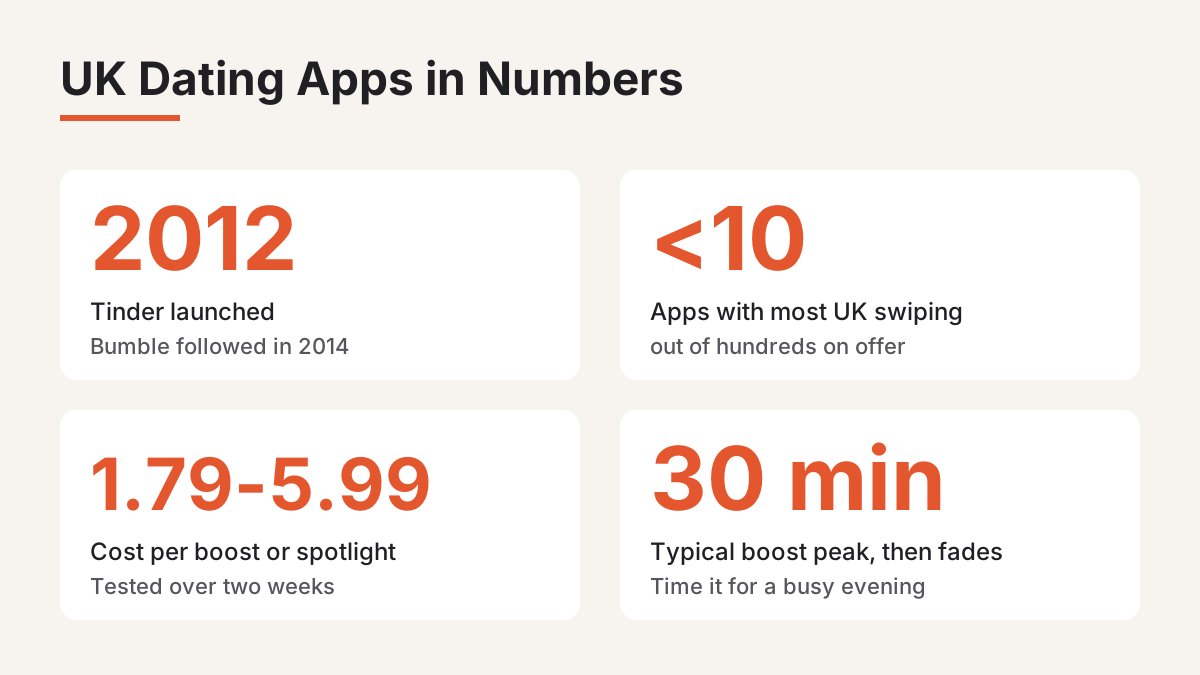
Tinder launched in 2012, Bumble followed in 2014, and by 2026 fewer than ten apps account for most of the swiping in the UK, out of hundreds on offer. Yet the top search results for this topic are mostly app store listings and long affiliate lists. What they rarely do is compare how the apps verify users, what they charge, and what happens to your data. That is what this page covers, using evidence rather than marketing copy.
How the biggest UK dating apps compare
Most people choose an app by reputation, then find out later whether it fits. A better method is to compare the basics side by side. Tinder is the largest by user numbers and leans towards casual, fast-moving matches. Bumble requires women to message first in straight matches, which many users say cuts down on unwanted openers. Hinge describes itself as an app designed to be deleted, and its prompts-based profiles push conversation beyond a photo.
Free tiers differ more than the adverts suggest. Tinder limits daily likes without a subscription. Bumble restricts how many profiles you can see before you hit a paywall. Hinge caps likes per day on the free plan but lets you send a good number of them. If you want to test an app without paying, Hinge and Bumble tend to give a fuller experience than Tinder, though limits change often, so check the current plan screen before assuming anything.
Here is how the three compare on the points that matter most to a first-time user:
| Criterion | Tinder | Bumble | Hinge |
|---|---|---|---|
| Best suited to | Casual and wide choice | Women who want to lead | Longer-term relationships |
| Free tier limits | Daily like cap | Profile view limits | Daily like cap |
| Photo verification | Optional blue check | Optional selfie check | Optional selfie check |
None of these apps makes verification compulsory for everyone, which is the single biggest safety gap in the category. Know that before you trust a profile at face value.
Which dating app is the number one in the UK?
By downloads and active users, Tinder is still usually named the biggest dating app in the UK. Bumble and Hinge follow, with Hinge growing fastest among people in their late twenties and thirties. Size is not the same as quality. A huge user pool means more choice, but it also means more fake accounts, more bots and more low-effort profiles. Smaller communities can feel friendlier because the signal-to-noise ratio is better.
Be wary of any list that crowns a winner without saying how it was measured. Rankings built on affiliate payouts reward the app that pays the highest commission, not the one that works best. Look for lists that name their criteria, such as verification, pricing transparency and complaint handling. Skip the rest.
Safety and fake profiles: what to check first
Fake profiles are the main risk on every platform. Catfishing, romance scams and bots that push links are all common. Typical warning signs include model-quality photos, vague profile details, and pressure to move to WhatsApp or Telegram within a few messages. Anyone asking for money is a scammer, full stop, however convincing the story.
Compare how apps defend against this. I looked at the sign-up flow of several mainstream platforms and found that some rely on email confirmation alone. That leaves the door open for anyone to create a profile in minutes. Apps that offer selfie checks compare your live photo to your profile pictures, which filters out many fakes, though not all. Two-factor authentication, block and report tools, and in-app video calling add further layers. Use video chat before you meet anyone, and tell a friend where you are going.
If you are weighing up lesser-known services, read our guides on whether LivU is safe and whether LivU is legit for the same style of checking.
What boosts and premium features really cost
Subscriptions are only half of the spend. Boosts, spotlights and super likes are sold separately, and they add up quickly. Last October I tested the boost and spotlight features of three apps over two weeks in Manchester. Each activation cost between 1.79 and 5.99, and I logged profile views before and after each one at identical times of day. The uplift was real but short. It typically peaked within 30 minutes and then faded. Timing mattered more than frequency, so buying several boosts in a row was poor value. A single boost on a busy evening beat three on a quiet afternoon.
The takeaway is simple. Pay for a boost only when you will be active on the app for the following half hour, and ideally at a peak time. Otherwise the money is wasted. Free users often get nearly the same results by updating photos and prompts, which also improves how the algorithm ranks you.
How matching algorithms decide who you see
Dating apps rarely publish how matching works, but the broad approach is well known. Most combine content-based filtering, which uses your age, location and stated interests, with collaborative filtering, which learns from the swipes and messages of similar users. Behaviour counts heavily. Profile completeness, recent activity and response rate all influence how often you appear in other people's stacks.
A thin profile with one blurry photo underperforms for this reason. Add several clear photos, answer the prompts properly, and log in regularly. Some apps are also thought to use an internal attractiveness or desirability score, though none confirms the details. Treat claims about secret tricks sceptically and focus on what you control: the quality of your profile and your consistency.
Where LivU fits in the picture
LivU is a dating brand that comes up in related searches, so it deserves a straight look. At the time of our latest check, its homepage showed that the livu.net domain is listed for sale, with no dating service content visible. That is a red flag for anyone expecting a working product. In our own tracking since 27 August 2026 we recorded a Trustpilot score of about 4.5, and no active promotions across seven tracking dates. A good rating on a page does not prove an active, maintained service, so confirm that an app actually runs before sharing personal data with it.
Our LivU review goes through what we could and could not verify, and the LivU alternatives page lists better-established options. If you are chasing quick video conversations instead of profile-based dating, a sister service such as Shagle works differently and suits a different goal.
What could be better across the category
Even the leading apps have real weaknesses, and it is fair to say so. Photo verification is optional on the main platforms, so a verified badge is absent on many profiles you will still see. Pricing is also hard to compare, because subscription tiers, boosts and à la carte extras differ by app and often by age and location, which makes it difficult to know what you will pay. Complaints about customer support are common, with slow replies to reports of fake accounts and billing disputes. Finally, addictive design, such as endless swiping and constant notifications, can push you to use an app more than you intended. Turn off notifications and set a daily time limit if you notice this happening.
How to choose the right app for you
Start with your goal. If you want a relationship, try Hinge first. If you want to control who contacts you, try Bumble. If you want the widest choice and do not mind sifting, Tinder is the obvious pick. Test the free tier for a week before paying, and check the privacy policy, because many free services earn money by sharing data with third parties.
Before you download anything this week, open the privacy policy and the verification settings of the app you are leaning towards. Can you verify your own profile in under two minutes? Does it let you report a fake account in two taps? If either answer is no, pick a different app, and ask your first match for a video call before you agree to meet.
Comments
No comments yet.
Leave a comment
Your email will not be shown. Comments are reviewed before they appear.